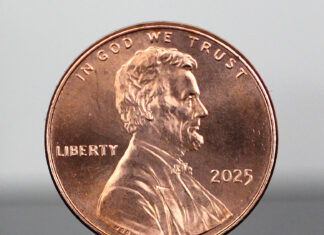
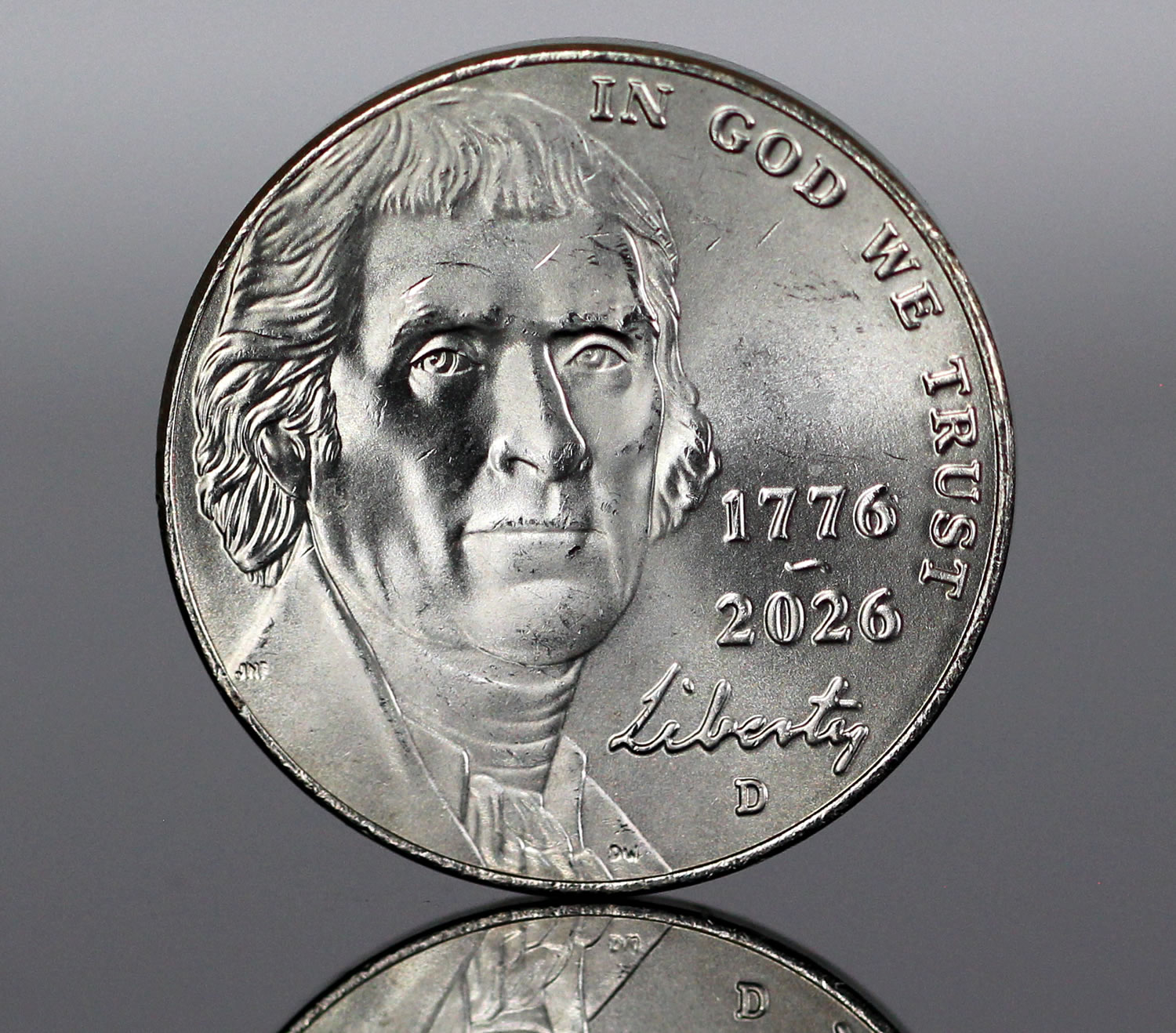
The U.S. Mint could eventually produce nickels with a zinc core and an outer layer of nickel under the Common Cents Act, signed into law by President Trump on Nov. 20. The legislation authorizes an alternative to the traditional copper-nickel alloy as five-cent coins continue to cost substantially more to manufacture and distribute than their face value.
Although primarily focused on ending circulating penny production, the law also gives Treasury greater flexibility over nickel composition and the authority to discontinue producing nickels for circulation altogether. Any composition change must demonstrate cost savings while minimizing adverse effects on coin-accepting equipment.
The law does not require a composition change, and no timetable has been announced for introducing one.
New Composition and Weight Standards
Jefferson nickels are composed of 75% copper and 25% nickel, an alloy used for the five-cent denomination since the introduction of the Shield nickel in 1866, apart from the wartime silver composition used during World War II.
Under the Common Cents Act, the five-cent coin may instead be produced with an inner layer of zinc and an outer layer of nickel. Treasury would determine the proportions of those metals, subject to testing and evaluation.
The legislation also establishes different weight requirements depending on the composition:
- Traditional copper-nickel coins remain authorized at their current 5-gram weight.
- Nickels using the alternative zinc-and-nickel composition could weigh between 4 and 6 grams.
Before adopting the new materials, Treasury must evaluate potential savings and compatibility with vending machines and other coin-accepting equipment.
No redesign is required by the law, and a change in metallic composition would not necessarily alter the nickel’s appearance.
Mint Has Studied Alternative Metals
The possibility of changing the nickel’s composition is not new. The U.S. Mint has spent years researching alternative metals for circulating coins to reduce manufacturing expenses while maintaining compatibility with existing coin-handling equipment.
In its 2024 Biennial Report to Congress, released in July 2025, the Mint identified an alloy of 80% copper and 20% nickel as ready for congressional authorization. The report estimated that using the alloy could have saved about $2.5 million across nickels, dimes and quarters at 2024 production levels, including approximately $600,000 on nickels alone.
A 2025 House Financial Services Committee report offered context for the zinc-based approach, which had been included in earlier Common Cents Act legislation. Citing testing by the Mint and private companies that indicated compatibility with existing coin-handling equipment, lawmakers pointed to zinc’s substantially lower cost compared with copper and nickel as a reason for authorizing the alternative.
Earlier Mint experiments with plated zinc compositions also encountered durability problems, including edge deformation and exposed zinc cores, underscoring the importance of further testing before any new nickel composition is adopted.
Nickels Cost 13.31 Cents to Produce
Nickel production and distribution costs have exceeded the denomination’s five-cent face value since fiscal 2006, resulting in 20 consecutive years of negative seigniorage.
According to the U.S. Mint’s 2025 Annual Report, the average cost to manufacture and distribute a nickel declined to 13.31 cents in fiscal 2025 from 13.78 cents in 2024, still more than 2.5 times its face value.
Nickel production generated negative seigniorage of $50.9 million on coins shipped in fiscal 2025, up from $17.7 million in fiscal 2024. Combined with $95.6 million in losses on pennies, the two denominations accounted for $146.5 million in negative seigniorage.
Seigniorage is the difference between a coin’s face value and its production and distribution costs. It becomes negative when those costs exceed face value.
U.S. Mint Coin Production Costs
Cost to produce and distribute each coin, in cents
| Denomination | FY 2022 | FY 2023 | FY 2024 | FY 2025 |
|---|---|---|---|---|
| Penny | 2.72¢ | 3.07¢ | 3.69¢ | 3.02¢ |
| Nickel | 10.41¢ | 11.54¢ | 13.78¢ | 13.31¢ |
| Dime | 5.03¢ | 5.30¢ | 5.76¢ | 6.77¢ |
| Quarter | 11.11¢ | 11.63¢ | 14.68¢ | 14.53¢ |
| Half dollar | 17.15¢ | 25.98¢ | 33.97¢ | 27.81¢ |
Source: U.S. Mint FY 2022–2025 Annual Reports
Unlike pennies and nickels, dimes and quarters remained profitable, generating $42.7 million and $130.5 million in seigniorage, respectively, during fiscal 2025.
Overall circulating coin seigniorage fell to $34.2 million from $99.5 million in fiscal 2024.
With circulating penny production now discontinued, the nickel remains the lowest-denomination coin being manufactured for everyday commerce. Its continued losses provide an incentive for Treasury to consider less expensive materials.
Potential Implications for Collectors
During World War II, the Mint temporarily replaced the traditional copper-nickel alloy with a composition of 56% copper, 35% silver and 9% manganese from late 1942 through 1945 to conserve nickel for military needs. Those wartime issues remain a distinct and widely collected part of the Jefferson nickel series.
If Treasury adopts the newly authorized composition, traditional copper-nickel issues and any future zinc-core versions could become distinct collecting categories, much as wartime silver nickels are today.
However, the legislation itself does not create a new coin variety or direct the Mint to adopt the alternative composition.
Treasury Gains Authority Over Other Denominations
Another provision of the Common Cents Act allows Treasury to discontinue minting other coin denominations for circulation, subject to congressional notification requirements.
Before ending production of another denomination, the Treasury secretary must provide the House Financial Services Committee and Senate Banking Committee with at least 60 days’ notice. The notice must explain the fiscal and operational reasons for discontinuation and include a comprehensive phaseout plan addressing potential effects on consumers, businesses and the economy.
Treasury must also brief the committees within 30 days after submitting that notice.
No other denomination is immediately discontinued, but Treasury can now make those decisions without additional legislation. For nickels, that means the same law providing a path toward cheaper production also allows Treasury to end their minting for circulation entirely, subject to congressional notification and planning requirements.