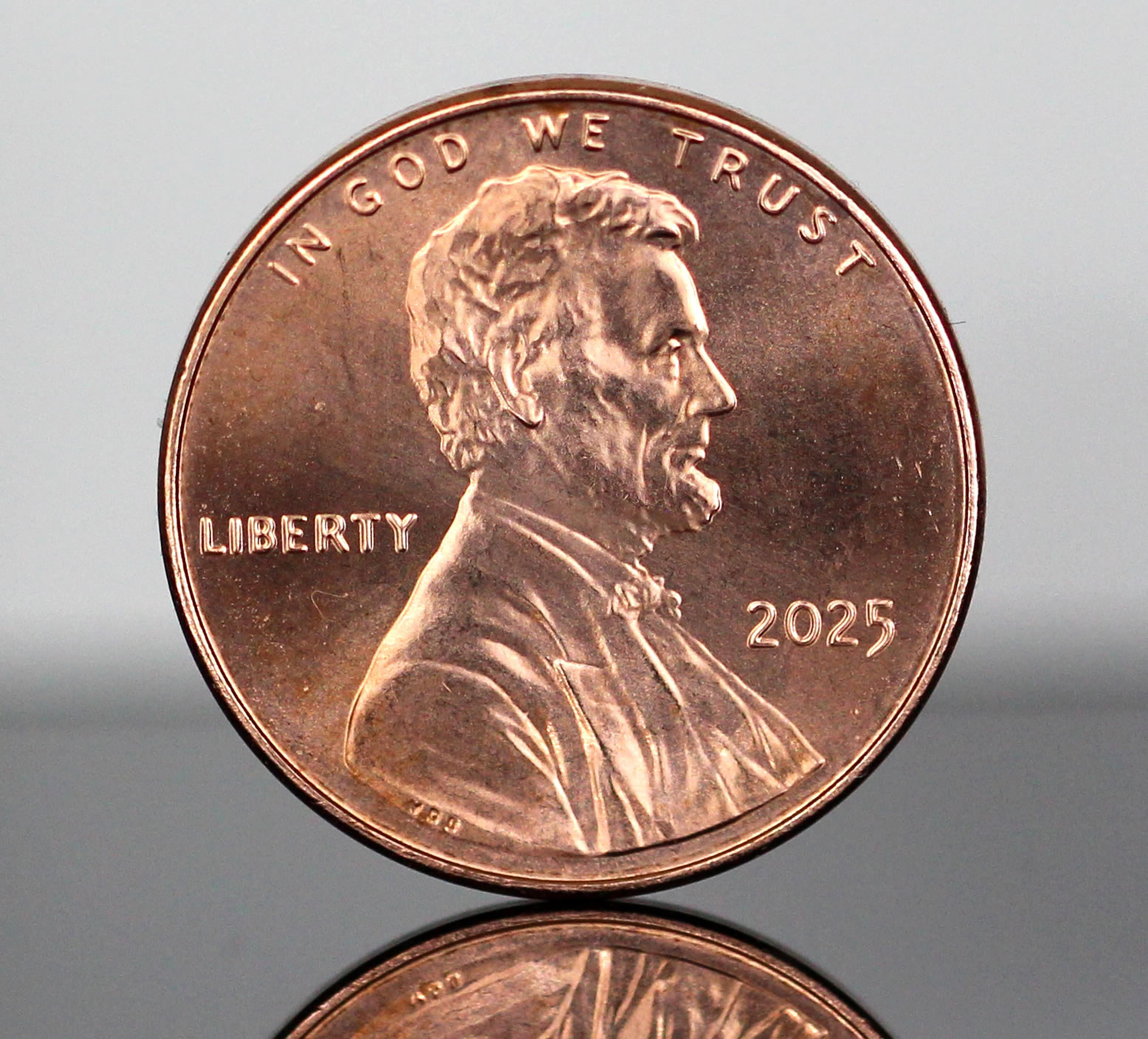
President Trump signed the Common Cents Act into law Friday, Nov. 20, formally ending production of pennies for general circulation while allowing the U.S. Mint to continue striking one-cent coins for collectors. Beyond pennies, the law gives Treasury greater flexibility to address coinage costs through potential changes to nickel composition and the discontinuation of other circulating denominations.
The bipartisan measure, H.R. 10167, follows a February 2025 directive from Trump to stop circulating penny production as a way to reduce government spending. On Nov. 12, 2025, the Mint marked the end of circulating penny production with a ceremonial final strike at its Philadelphia facility, closing a 232-year chapter in U.S. coinage history.
Specially marked examples of the final 2025 cents, bearing an Omega privy mark, were later sold by Stack’s Bowers Galleries on behalf of the Mint in 232 three-coin sets that collectively realized more than $16.76 million.
Introduced in the House by Rep. Lisa McClain, R-Mich., with Rep. Robert Garcia, D-Calif., as an original cosponsor, the legislation followed a similar bipartisan Senate effort led by Sens. Cynthia Lummis, R-Wyo., and Kirsten Gillibrand, D-N.Y. The House passed the measure on Sept. 14, followed by the Senate on Sept. 28.
Collector Pennies Remain Authorized
For numismatists, one of the law’s most important provisions preserves the U.S. Mint’s authority to produce and issue one-cent coins for sale as collectible items.
That exception allows the Mint to issue future collector editions of the cent, even though production for everyday commerce has ended. The Mint has already continued the denomination in its clad 2026 Proof Set, 2026 Silver Proof Set and uncirculated 2026 Mint Set, each containing Lincoln cents bearing the 1776 ~ 2026 dual date for America’s 250th anniversary. Only the clad proof set remains available directly from the Mint, with the other two unavailable for some time as sales approached their respective product limits.
Existing pennies also remain legal tender. The law explicitly protects the legal tender status of one-cent coins minted and issued before its enactment, allowing them to continue being used for purchases and payments.
Another provision removes the statutory requirement that one-cent coins weigh 3.11 grams while retaining the requirement that they be composed of copper and zinc. The law does not specify a replacement weight, and no changes to the specifications of future collector cents have been announced.
Penny Production Costs and Savings
Penny production and distribution costs have exceeded the coin’s one-cent face value since 2006, resulting in two decades of losses and contributing to the decision to end production for circulation.
According to the U.S. Mint’s 2025 Annual Report, production and distribution costs declined for four of the five circulating coin denominations compared with fiscal 2024, when costs had risen across all five denominations. Even with those reductions, nickels continued to cost substantially more than their face value.
U.S. Mint Coin Production Costs
Cost to produce and distribute each coin, in cents
| Denomination | FY 2022 | FY 2023 | FY 2024 | FY 2025 |
|---|---|---|---|---|
| Penny | 2.72¢ | 3.07¢ | 3.69¢ | 3.02¢ |
| Nickel | 10.41¢ | 11.54¢ | 13.78¢ | 13.31¢ |
| Dime | 5.03¢ | 5.30¢ | 5.76¢ | 6.77¢ |
| Quarter | 11.11¢ | 11.63¢ | 14.68¢ | 14.53¢ |
| Half dollar | 17.15¢ | 25.98¢ | 33.97¢ | 27.81¢ |
Source: U.S. Mint FY 2022–2025 Annual Reports
Despite the lower per-coin cost, penny production generated negative seigniorage of $95.6 million in fiscal 2025, compared with $85.3 million in fiscal 2024. Seigniorage is the difference between a coin’s face value and its production and distribution costs. It becomes negative when those costs exceed face value.
Treasury estimates that ending circulating penny production will save approximately $56 million annually in material costs, with additional savings possible through operational changes.
Cash Rounding Rules Established
With no new pennies entering circulation, the Common Cents Act establishes nationwide guidelines allowing businesses and financial institutions to round cash transactions to the nearest five cents when exact change cannot be provided.
Under the provisions:
- Amounts ending in 1, 2, 6 or 7 cents may be rounded down to the nearest nickel.
- Amounts ending in 3, 4, 8 or 9 cents may be rounded up.
- Small transactions totaling 1 or 2 cents may be rounded up to 5 cents.
Rounding is voluntary. Businesses with sufficient pennies may still provide exact change, while those unable to do so may use the standard rules. The law also permits adjustments in the customer’s favor, regardless of whether exact change is available — down when customers pay cash and up when businesses pay customers.
For example, a cash purchase totaling $18.67 may be rounded down to $18.65, while one totaling $24.38 may be rounded up to $24.40. The rules can apply to the full transaction amount, including taxes, or to the amount of change owed to the customer.
Payments made by credit card, electronic transfer, check, gift card, money order and similar methods are unaffected.
Businesses and financial institutions following the law’s rounding provisions also receive protections under federal, state, tribal and local requirements. The nationwide framework addresses uncertainty that retailers have faced as penny shortages spread and differing state rules complicated cash transactions. Those protections do not override minimum-wage, overtime or paid-leave laws.
Federal Reserve to Review Penny Distribution
Although new circulating pennies are no longer being produced, Treasury estimates that roughly 114 billion remain in existence. They retain their face value and can still be spent, deposited or kept by collectors. The Federal Reserve is expected to continue recirculating existing supplies for as long as practicable.
Within 90 days of enactment, the Federal Reserve Board must submit a publicly available report outlining a strategy for managing penny orders and deposits at commercial coin terminals, limiting supply disruptions and maintaining an efficient distribution system.
Treasury must also assess how penny supply disruptions and rounding practices for check cashing affect low-income communities, older consumers and people without full access to banking services. The assessment must include recommendations to Congress for addressing any adverse impacts identified.
Additional Federal Reserve evaluations are due 6, 18 and 30 months after the initial report to assess the transition and identify any emerging problems in penny distribution.
The Common Cents Act also authorizes a potentially lower-cost composition for nickels and gives Treasury authority to discontinue production of other circulating coin denominations. Before ending production of another denomination, Treasury must notify congressional banking committees at least 60 days in advance and submit a phaseout plan addressing potential effects on consumers, businesses and the economy.