In 2024, the U.S. Mint American Women Quarters™ Program will enter its third year of a four-year series that aims to recognize the valuable role of women in American history. The Commission of Fine Arts (CFA) and the Citizens Coinage Advisory Committee (CCAC) has already reviewed reverse designs for the five 2024 quarters honoring Patsy Takemoto Mink, Mary Edwards Walker, Pauli Murray, Zitkala-Ša, and Celia Cruz.
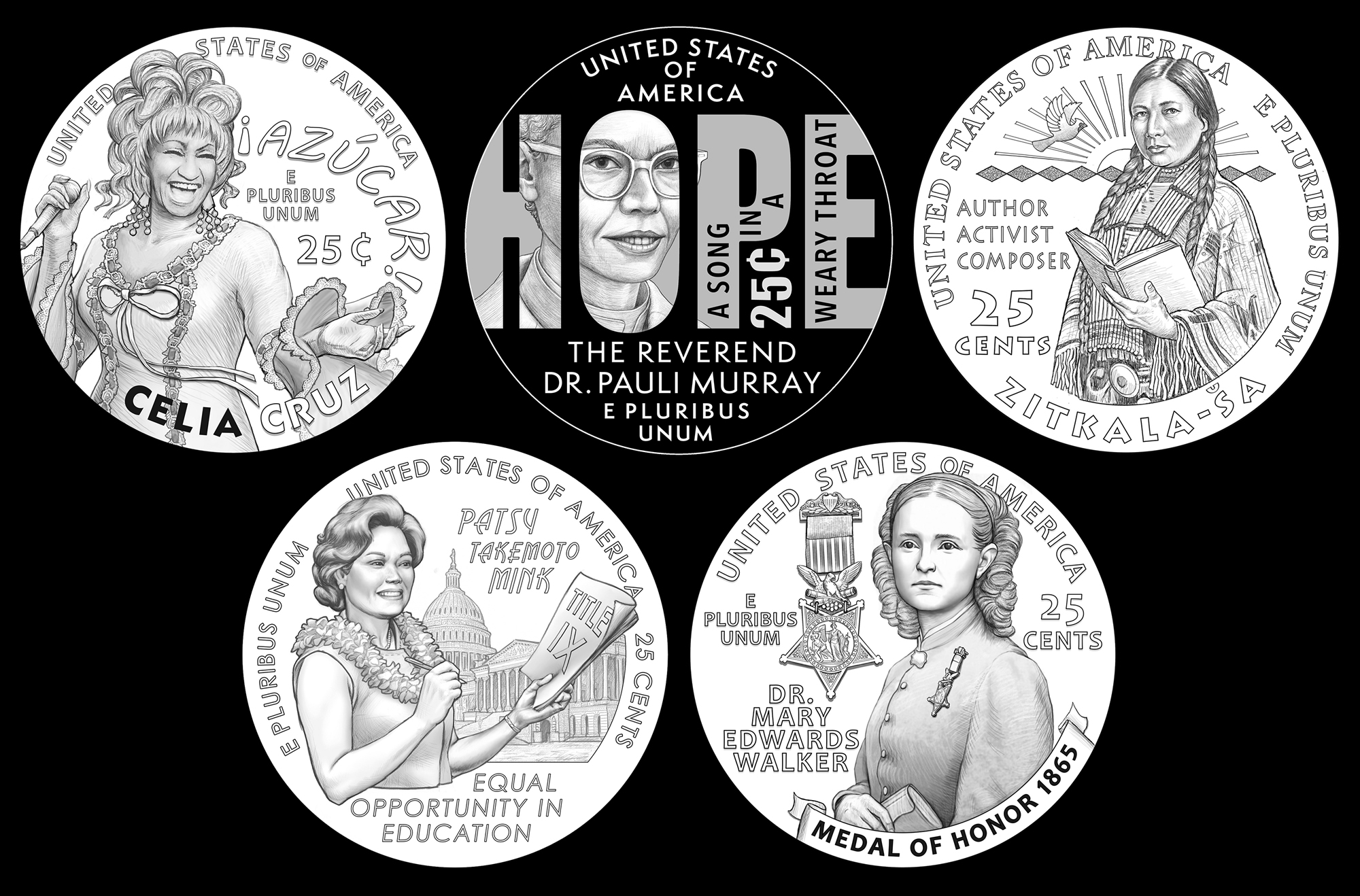
CoinNews is catching up with the recommendations submitted by the CFA on Feb. 24 and the CCAC on March 10 regarding forty candidate designs for the quarters. Ultimately, both bodies expressed a high degree of agreement on many, but not all, of the designs to recommend.
Below are their recommendations provided to Treasury Secretary Janet Yellen, who is responsible for making final selections on designs for new coins.
Celia Cruz Quarter Design Recommended
Cruz was a naturalized Cuban-American singer who became one of the most popular artists of the 20th century. Born in Cuba, she left the country after the 1959 Cuban revolution, despite already being a star, becoming a de facto spokesperson for Cuban exiles.
Cruz sang with the group Sonora Matancera and the Tito Puente orchestra among others, but really came to fame as a solo artist. Her operatic range as a salsa singer would eventually earn her recognition as the "Queen of Salsa."
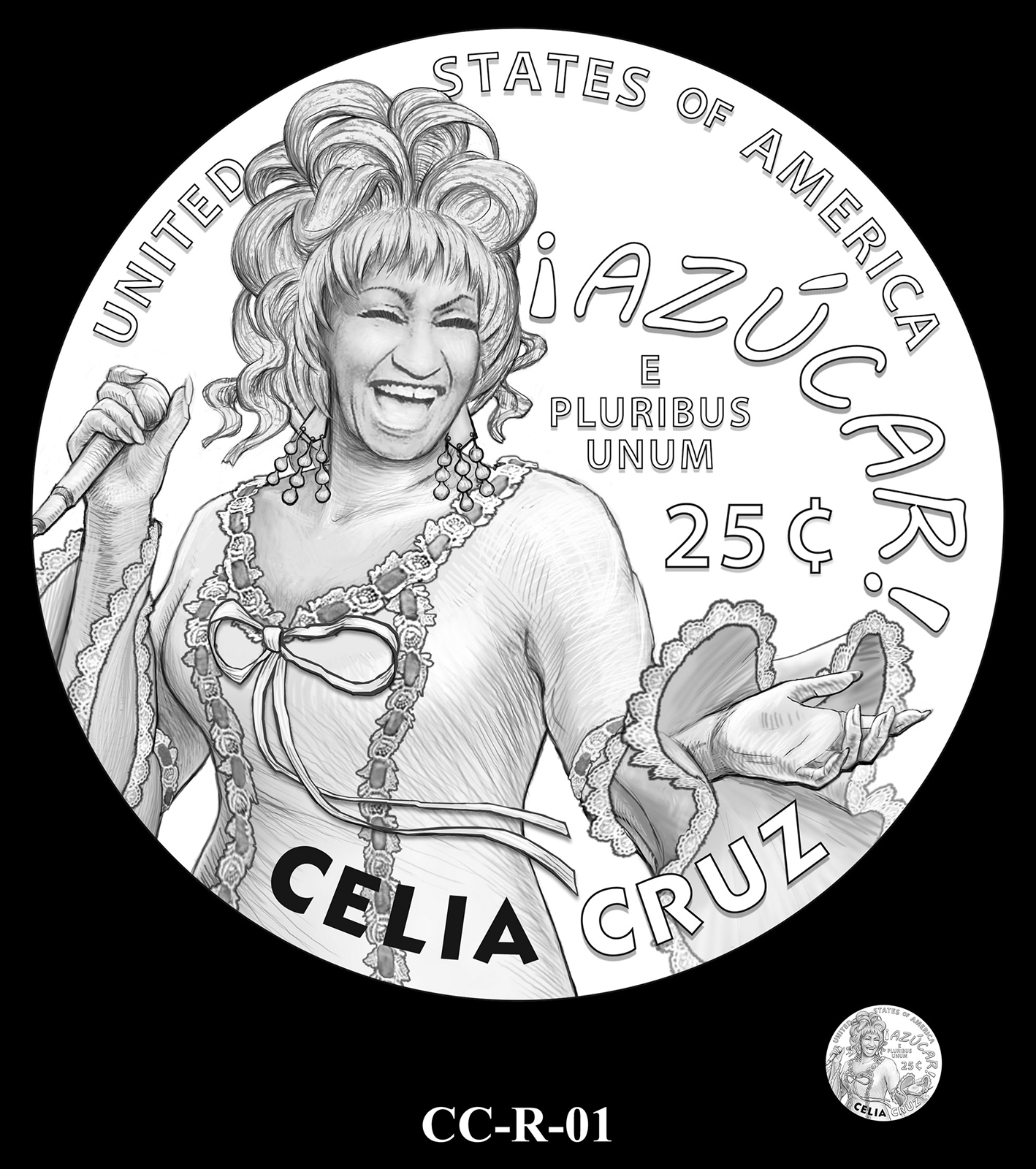 |
CFA: Consistent with the preference of Ms. Cruz’s estate representative, the Commission members recommended alternative CC-R-01, commenting that her prominence as a salsa singer is best conveyed by the lively composition, the microphone in her hand, and her distinctive Spanish-language phrase, "AZUCAR!"
CCAC: Mr. Omer Pardillo, former manager to Ms. Cruz and executor of her estate, joined the CCAC for discussion of the six reverse candidate designs. The CCAC recommended unanimously reverse design CC-R-01, which portrays Ms. Cruz with her dazzling smile while performing in a rumba style dress with her signature catchphrase "AZUCAR!" inscribed on the coin. This design was also favored by Mr. Pardillo and the US Commission on Fine Arts (CFA)
Rev. Dr. Pauli Murray Quarter Designs Recommended
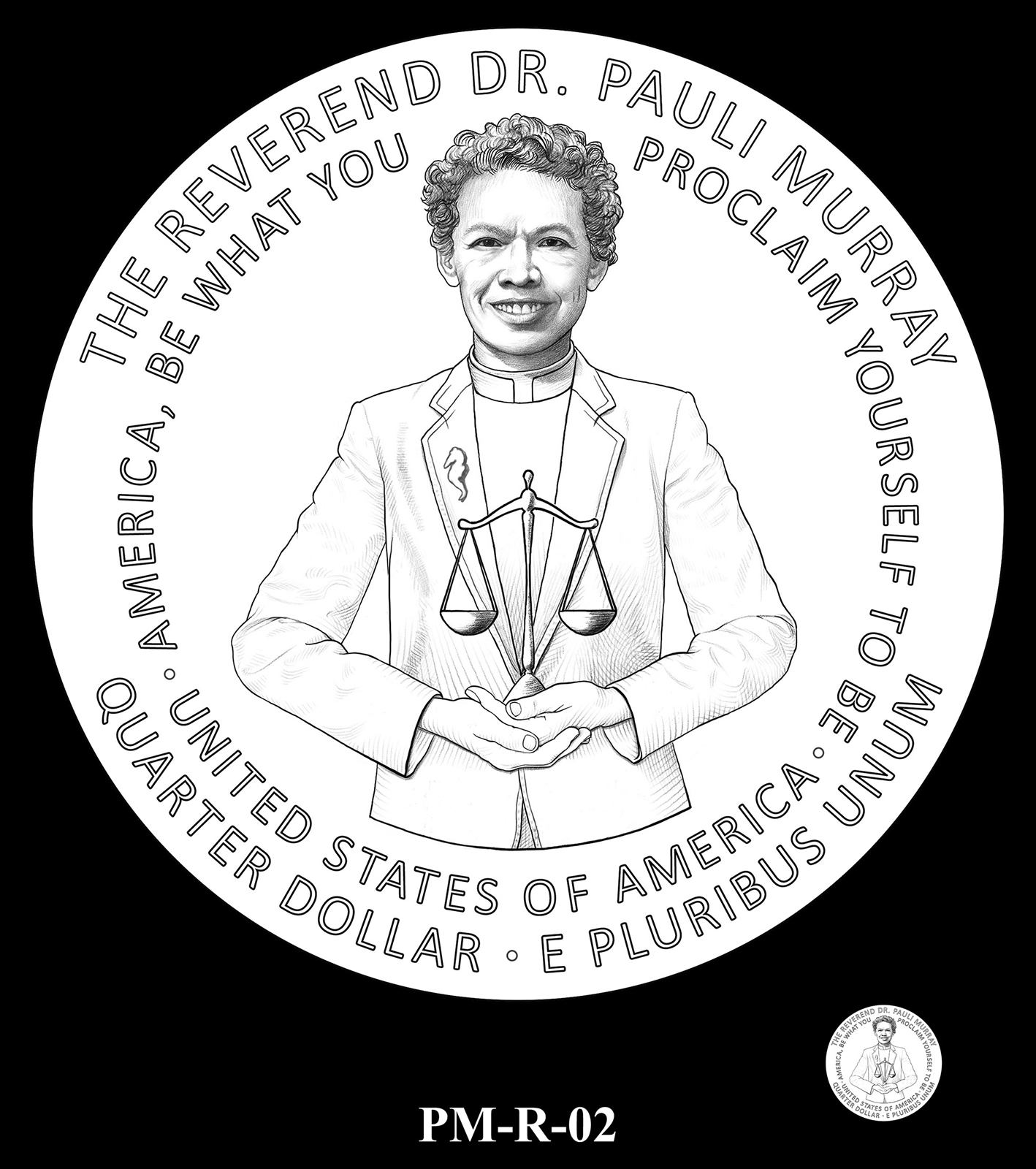
Murray was orphaned at an early age but fought to overcome any disadvantage because of it. She graduated first in her class at Howard University and became the first African American woman to earn a Doctor of Juridical Science degree from Yale Law School, using it to advance her causes of Civil and Women’s Rights issues.
She eventually felt a calling and became an Episcopal priest. She is recognized today as one most influential social justice advocates of the 20th century.
 |
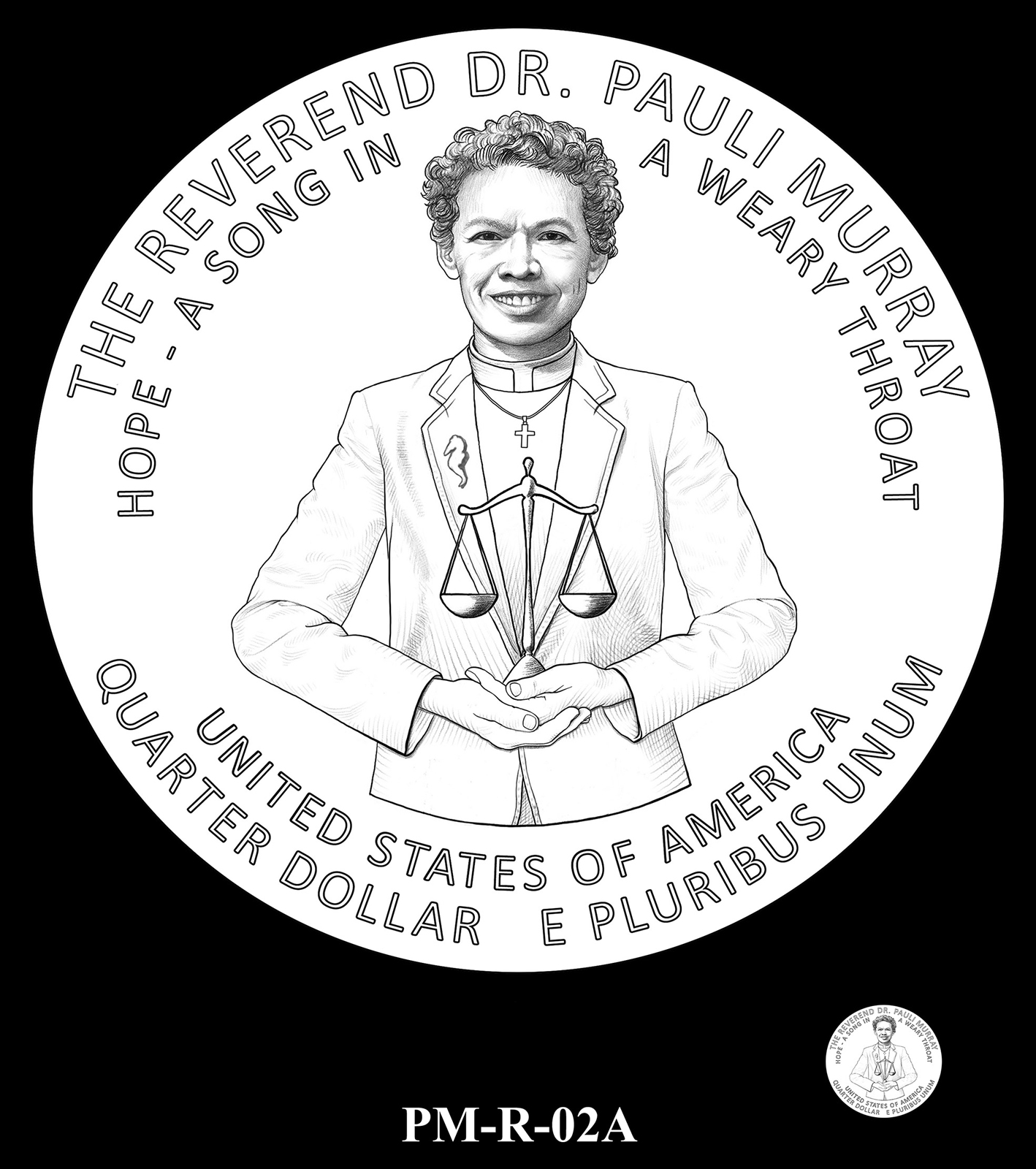 |
CFA: Consistent with the preference of Dr. Murray’s estate representative, the Commission members recommended alternative PM-R-02 with the inclusion of the pendant cross as seen in alternative PM-R-02A. They cited the strength of the portrait and the powerful quotation on PM-R-02, which conveys Dr. Murray’s energetic advocacy for civil rights.
 |
CCAC: For the discussion of the six reverse candidate designs, the CCAC was joined by Ms. Karen Ross, the great niece of Reverend Dr. Pauli Murray and founder of the Pauli Murray Foundation. Following a robust discussion, the CCAC recommended unanimously reverse design PM-R-01A, containing a portrait of Reverend Dr. Pauli Murray within the shape of the letter "O" in the word "HOPE." While not initially favored by Ms. Ross, during our discussion she came to endorse this design due to its uniqueness.
Patsy Takemoto Mink Quarter Designs Recommended
Mink has the distinction of being the first woman of color and the first Asian-American to serve in Congress. She was a Democratic member of the U.S. House of Representatives for 24 years despite repeated attempts from her own party to defeat her.
However, Mink’s tenacity towards issues such as gender equality, racial equality, health care and education would assure her favor with her constituents and cement her place in history as a formidable politician.
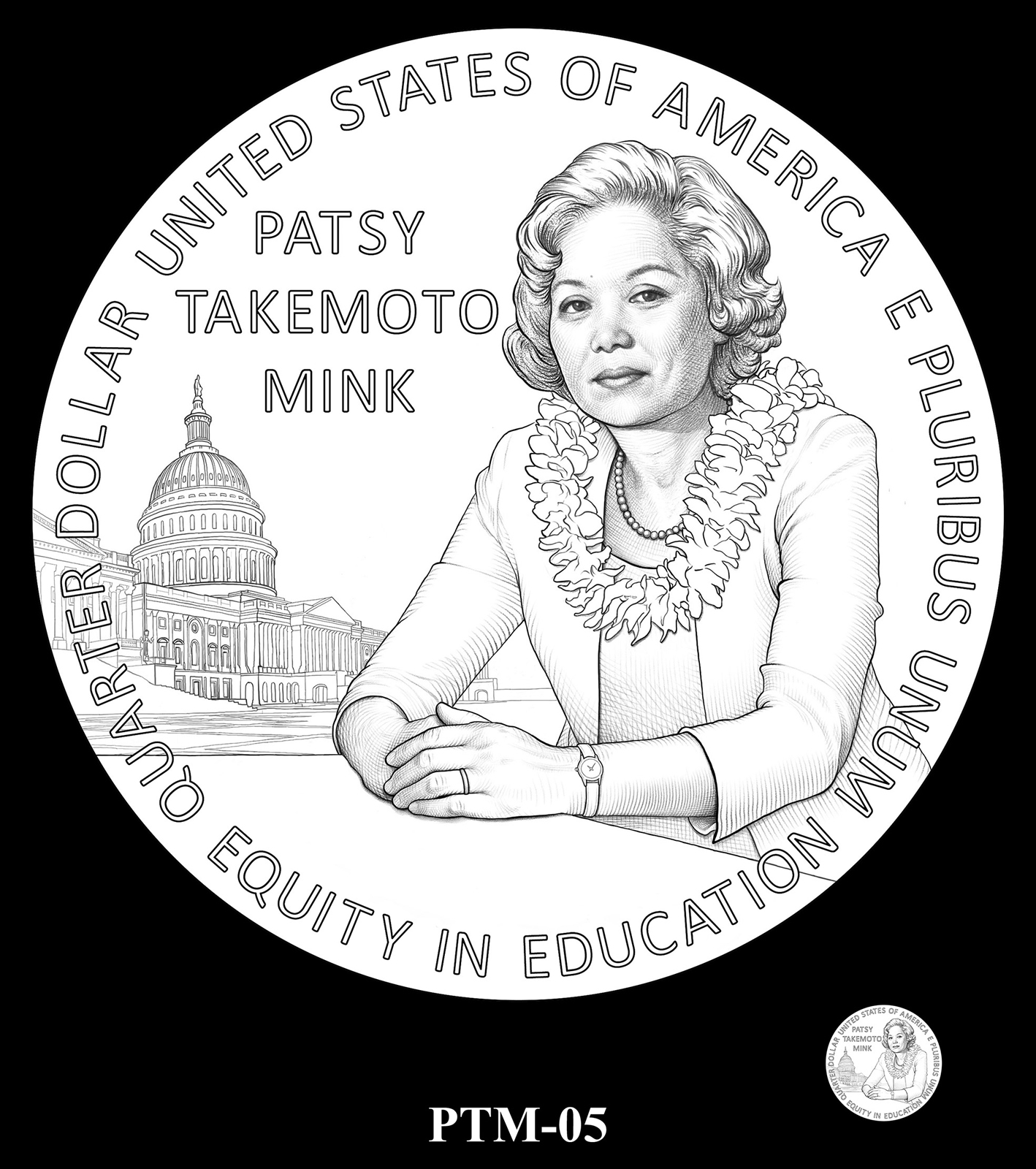 |
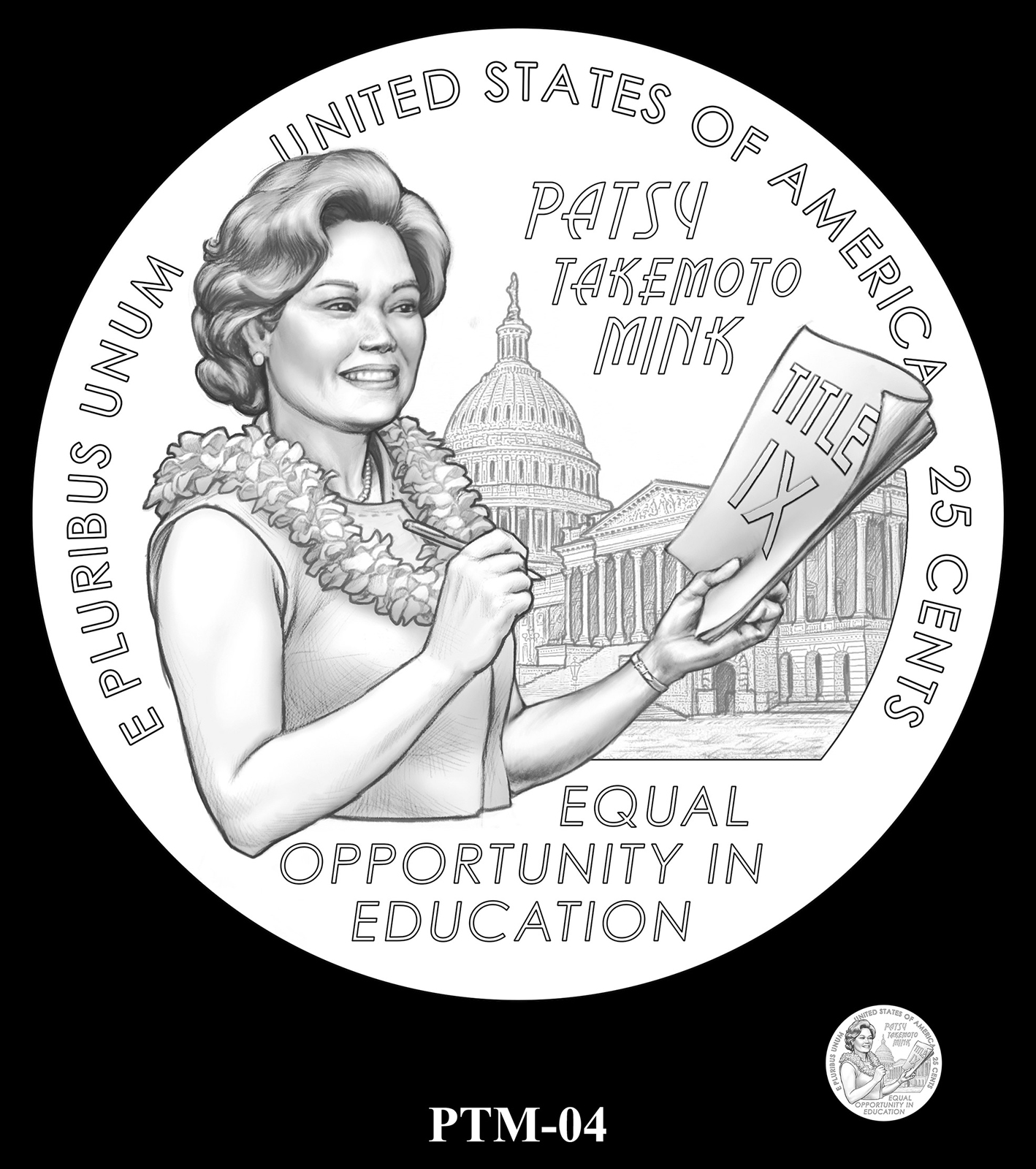
CFA: Consistent with the preference of the family liaison, the Commission members recommended alternative PTM-05, citing the dignified portrait and the inscription "Equity in Education," which will be more widely understood than "Title IX" as a reference to her most notable legislative work.
 |
|
CCAC: The CCAC was fortunate to have her daughter, Ms. Gwendolyn Mink, join the discussion, reviewing the five reverse candidate designs. Following a robust discussion, involving Ms. Mink on many occasions, the CCAC voted to recommend to the Secretary of Treasury both reverse candidate designs PTM-04 and PTM-05. Ms. Mink shared that she too sees the merits of both the designs recommended by the CCAC. The CCAC’s recommendation was with the knowledge that the CFA favored PTM-05. Finally, the CCAC also recommended that should the Secretary select design PTM-05 that delimiters be used to separate the different inscriptions.
Zitkala-Ša Quarter Design Recommended
Zitkala-Ša (meaning "Red Bird"), also known as Gertrude Simmons Bonnin, was born on the Yankton Indian Reservation in South Dakota on February 22, 1876. Despite her mother’s disapproval, she went with Quaker missionaries at the age of eight to Wabash, Indiana to learn to read, write and play the violin and piano.
She used the education to become a music teacher and would eventually compose the libretto and songs for the opera Sun Dance based on a sacred Sioux ritual that the federal government had prohibited.
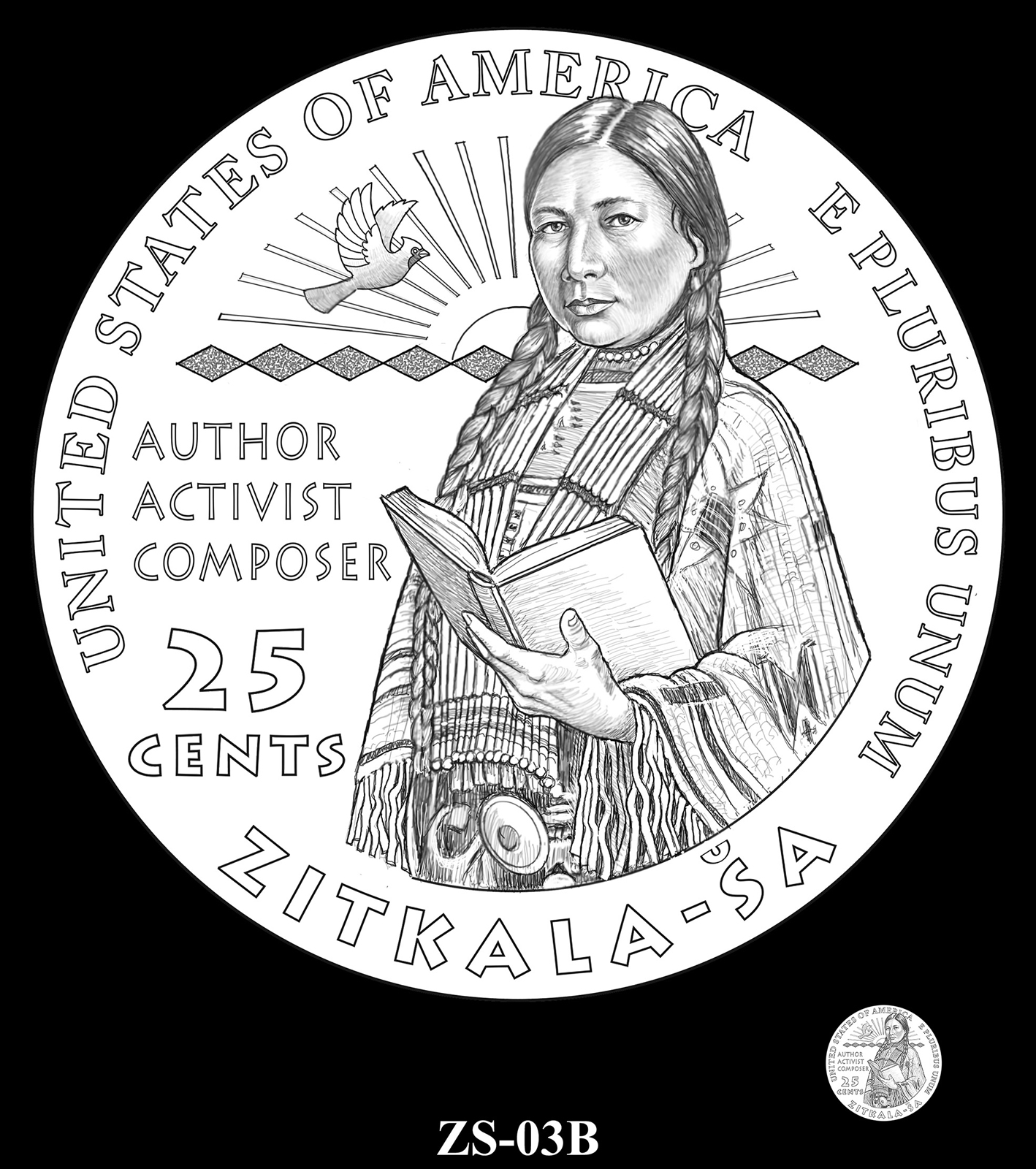 |
CFA: Consistent with the preference of the family liaisons, the Commission members recommended alternative ZS-03B, which conveys a determined expression in the portrait, as well as the symbols of a cardinal and a book, which refer to her Lakota name and to her literary achievements.
CCAC: Joining the CCAC during its review of the ten reverse candidate designs, was her great granddaughter, Ms. Holly Brown Ogle, and her great-great grandson Mr. Mark Bonnin. The CCAC recommended reverse candidate design ZS-03B with a score of thirty points out of a maximum score of thirty. This design, which was also favored by the family and the CFA, depicts Zitkala-Ša with a determined expression and includes inscriptions "AUTHOR," "ACTIVIST," and "COMPOSER".
Dr. Mary Edwards Walker Quarter Design Recommended
Walker became a surgeon in 1855 at a time when very few other women would even consider such a career. Her brave demeanor would not stop there, however. With the start of the American Civil War, Walker attempted to join the Union Army as a medical officer but was denied because of her gender. She volunteered, nonetheless, eventually receiving her commission as the first female surgeon in the army.
While assisting a Confederate doctor across enemy lines with wounded, she was arrested as a spy and held as a prisoner of war for four months. After the war, she received the Medal of Honor becoming the only woman to have ever attained that distinction. She is also remembered for her support of women’s rights and the end of slavery.
 |
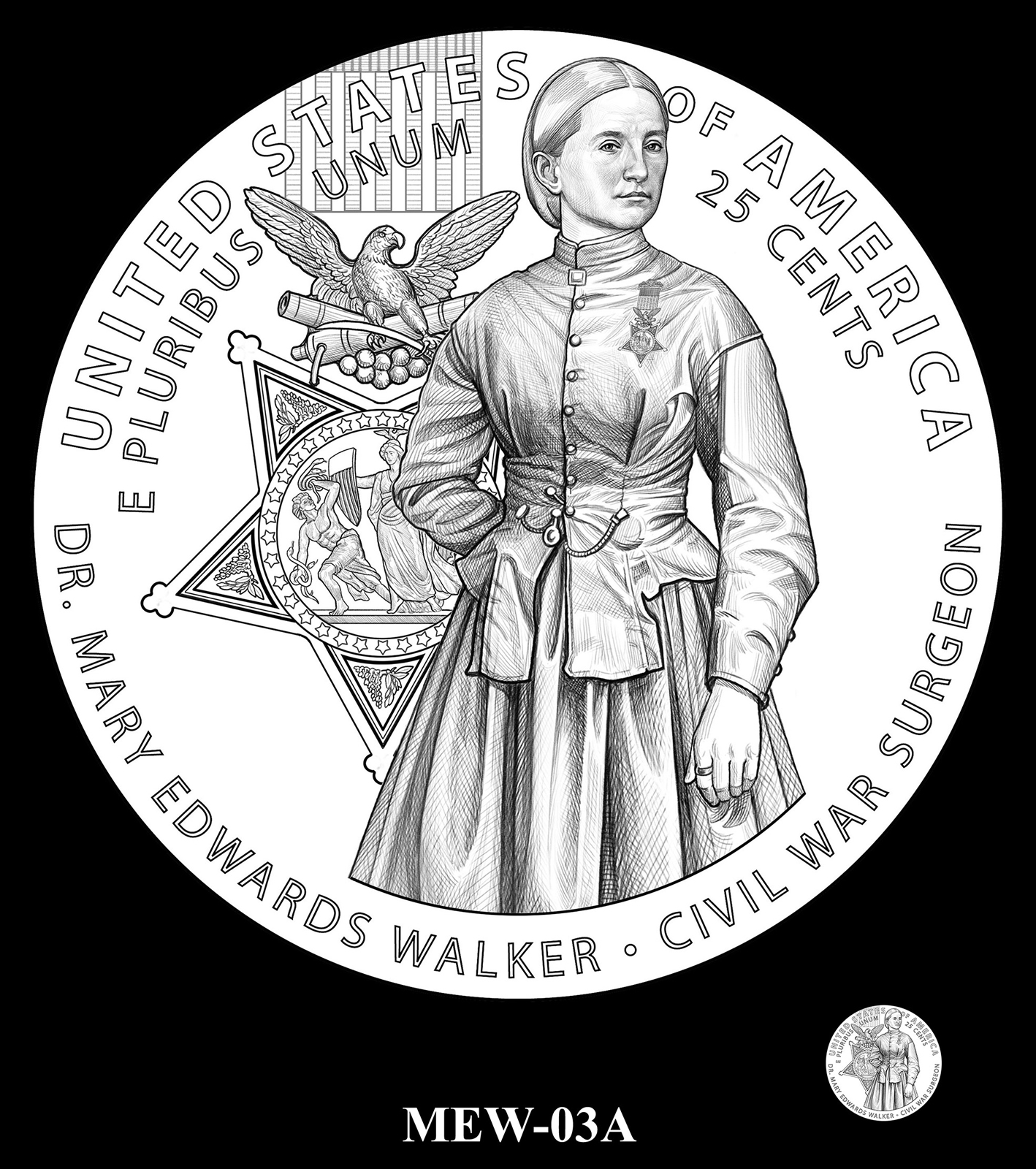 |
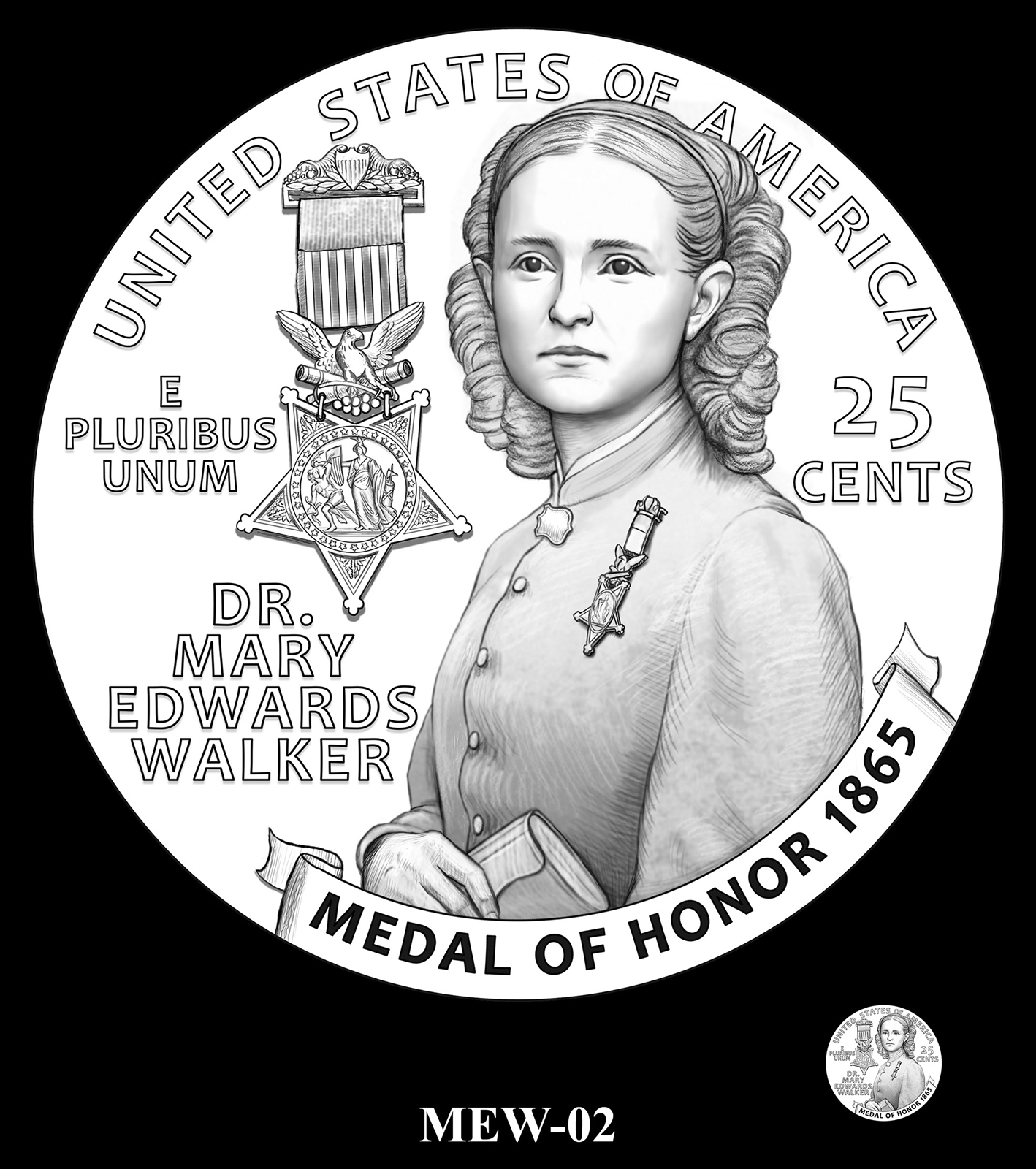
CFA: The Commission members recommended combining the portrait of alternative MEW-02 — the preference of Dr. Walker’s family representative — with the layout of alternative MEW-03A, which they said provides a better composition and a simpler depiction of the Medal of Honor. They commented that the inscription "Civil War Surgeon" and the nearly full-length portrait in MEW-03A better illustrate her profession and era.
|
CCAC: Mr. George DeMass, a historian from Oswego, New York, joined the CCAC to review the thirteen reverse candidate designs. Based upon helpful historical input from the liaisons, the CCAC recommended reverse candidate design MEW-02 with a score of thirty points out of a maximum score of thirty. This design was also favored by the liaisons.