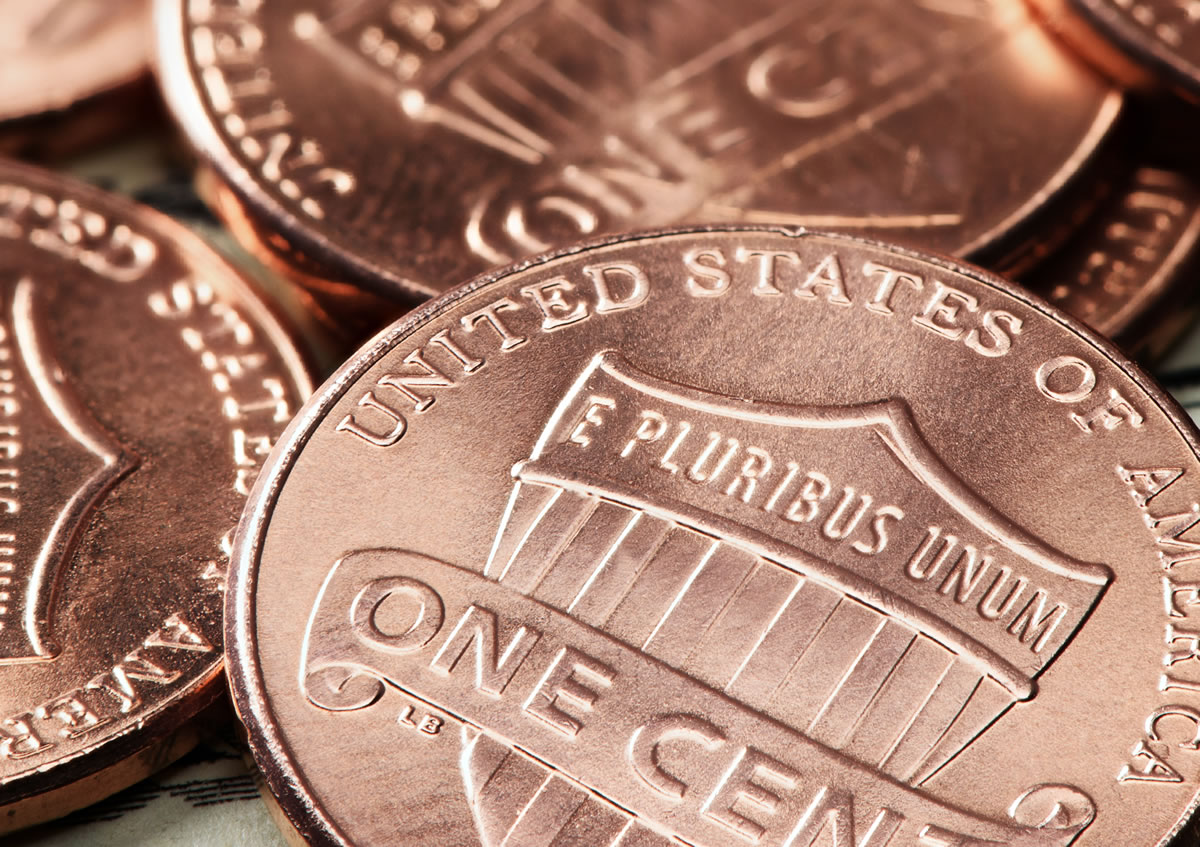
The price for manufacturing U.S. coins for circulation went up last year, except for the half dollar, the United States Mint disclosed this month in its 2021 Annual Report. And for a sixteenth straight year, the unit cost for both cents and nickels was above their face values.
The Mint struck nearly 15 billion coins for circulation during the fiscal year.
"Despite operating under continued restrictions due to COVID-19, the Mint shipped 14.7 billion circulating coins during FY 2021. This increased level of circulating coin production was necessary to meet increased coin orders from the Federal Reserve," the U.S. Mint’s annual report said
In FY 2021, the toll to make, administer and distribute the 1-cent coin climbed to 2.1 cents from 1.76 cents while the cost for the 5-cent coin increased to 8.52 cents from 7.42 cents. Higher prices for copper and zinc accounted for much of the increases.
"Compared to last year, FY 2021 average spot prices for nickel increased 28.1 percent to $17,503.10 per tonne, average copper prices also increased 48.2 percent to $8,676.77 per tonne, and average zinc prices increased 27.9 percent to $2,821.12 per tonne," the U.S. Mint noted.
Lincoln cents have a composition of 2.5% copper with the balance zinc. Five-cent coins are minted in 25% nickel with the balance copper. Dimes, quarters, and half dollars are each composed in 8.33% nickel with their balance copper.
Cost to Make Dimes, Quarters and Half Dollars
Unlike for cents and nickels, the U.S. Mint made money in striking dimes, quarters, and half dollars because the cost of manufacturing and distributing them was lower than their face values.
In FY2021, the unit cost for the quarter increased to 9.63 cents from 8.62 cents and the dime’s unit cost rose to 4.39 cents from 3.73 cents. The unit cost for the half dollar, meanwhile, decreased to 11.67 cents from 25 cents — supported by an increase in the number of half dollars made and shipped to Federal Reserve Banks.
The following two tables summarize U.S. Mint costs for the cent through half dollar in fiscal years 2020 and 2021.
FY 2021 Unit Cost to Produce and Distribute 1c, 5c, 10c, 25c, and 50c Coins
| One-Cent | Five-Cent | Dime | Quarter | Half Dollar | |
| Cost of Goods Sold ($) | 0.0181 | 0.0744 | 0.0386 | 0.0843 | 0.0917 |
| Sales, General & Administrative ($) | 0.0026 | 0.0095 | 0.0047 | 0.0106 | 0.0167 |
| Distribution to Reserve Banks ($) | 0.0003 | 0.0013 | 0.0006 | 0.0014 | 0.0083 |
| Total Unit Cost ($) | 0.0210 | 0.0852 | 0.0439 | 0.0963 | 0.1167 |
FY 2020 Unit Cost to Produce and Distribute 1c, 5c, 10c, 25c, and 50c Coins
| One-Cent | Five-Cent | Dime | Quarter | Half Dollar | |
| Cost of Goods Sold ($) | 0.0151 | 0.0653 | 0.0326 | 0.0760 | 0.2500 |
| Sales, General & Administrative ($) | 0.0022 | 0.0080 | 0.0042 | 0.0091 | – |
| Distribution to Reserve Banks ($) | 0.0003 | 0.0009 | 0.0005 | 0.0011 | – |
| Total Unit Cost ($) | 0.0176 | 0.0742 | 0.0373 | 0.0862 | 0.2500 |
In profit from seigniorage — the difference between the face value and cost of producing and distributing circulating coins, the dime in FY 2021 realized $172 million while the quarter brought $349.3 million. (The U.S. Mint transfers seigniorage to the Treasury General Fund to help finance national debt.) Relatively few half dollars were produced for circulation compared to other denominations, but the U.S. Mint still earned $4.6 million for them.
In contrast, the cent and nickel have lost money since 2006.
Unit Costs and Seigniorage for Cent and Nickel from 2005 to 2021
| Fiscal Year | Lincoln Cent Unit Cost | Jefferson Nickel Unit Cost | Combined 1c and 5c Seigniorage (in millions) |
| 2005 | 0.0097 | 0.0484 | $4.40 |
| 2006 | 0.0121 | 0.0597 | ($32.90) |
| 2007 | 0.0167 | 0.0953 | ($98.60) |
| 2008 | 0.0142 | 0.0883 | ($47.00) |
| 2009 | 0.0162 | 0.0603 | ($22.00) |
| 2010 | 0.0179 | 0.0922 | ($42.60) |
| 2011 | 0.0241 | 0.1118 | ($116.70) |
| 2012 | 0.0200 | 0.1009 | ($109.20) |
| 2013 | 0.0183 | 0.0941 | ($104.50) |
| 2014 | 0.0166 | 0.0809 | ($90.50) |
| 2015 | 0.0143 | 0.0744 | ($74.40) |
| 2016 | 0.0150 | 0.0632 | ($66.80) |
| 2017 | 0.0182 | 0.0660 | ($89.80) |
| 2018 | 0.0206 | 0.0753 | ($119.00) |
| 2019 | 0.0199 | 0.0762 | ($102.90) |
| 2020 | 0.0176 | 0.0742 | ($101.00) |
| 2021 | 0.0210 | 0.0852 | ($144.60) |
The U.S. Mint produces and issues circulating coins to Federal Reserve Banks in quantities to support their service to commercial banks and other financial institutions. FY 2021 compared to the prior year saw both production increases and decreases among denominations. In summary, the Mint delivered a total of:
- 7.613 billion cents, down 6.8% from the previous year;
- 1.736 billion nickels, up 8.6% from the previous year;
- 3.066 billion dimes, up 9.5% from the previous year;
- 2.274 billion quarters, down 21.8% from the previous year; and
- 12 million half dollars compared to no shipments in the previous year.
The five denominations combined to 14.701 billion coins, registering a 5% decrease from the 15.479 billion coins delivered in FY 2020.
The Fed pays face value for each coin they receive and, as such, the U.S. Mint’s FY 2021 circulating revenue for coinage totaled $1,044 million, down 10.7% from $1,168.5 million in FY 2020.
2021 Coin Shipments, Costs and Seigniorage
(coins and dollars in millions)
| One-Cent | Five-Cent | Dime | Quarter | Half Dollar | Mutilated & Other | Total | |
| Coins Shipments | 7,613 | 1,736 | 3,066 | 2,274 | 12 | – | 14,701 |
| Value of Shipments | $76.1 | $86.8 | $306.6 | $568.5 | $6 | – | $1,044.0 |
| Gross Cost | $159.7 | $147.8 | $134.6 | $219.2 | $1.4 | $0.1 | $662.8 |
| Seigniorage | ($83.6) | ($61.0) | $172.0 | $349.3 | $4.6 | ($0.1) | $381.2 |
After subtracting the year’s cost to produce the coins, which totaled $662.8 million, the U.S. Mint’s circulating profit or seigniorage totaled $381.20 million, representing a drop of $168.7 million, or 30.7%, from $549.9 million in FY 2020.
The Federal Government operates on a fiscal year that begins on October 1 and ends on September 30.