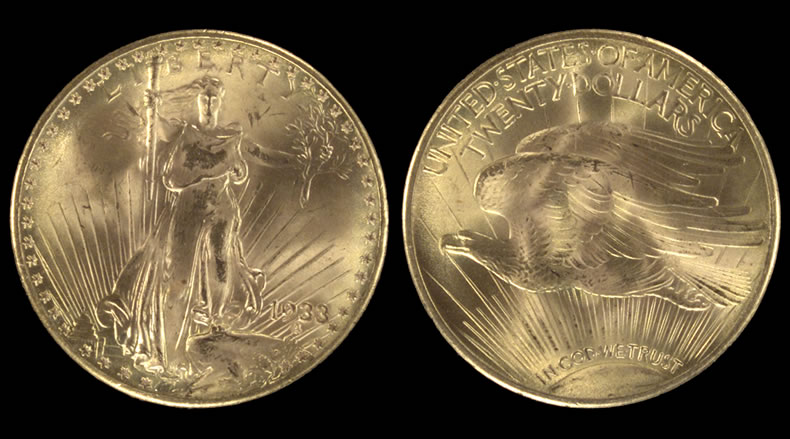
The 3rd U.S. Circuit Court of Appeals in Philadelphia determined that the United States Mint must return ten 1933 $20 Saint-Gaudens double eagles to a family in Pennsylvania.
The three-judge appeals court ruled 2-1 that ownership of the gold pieces should be reinstated to Joan Langbord and her sons, Roy and David, because they were improperly seized, based on the failure to initiate a timely forfeiture action as required by the Civil Asset Forfeiture Reform Act (CAFRA).
"If the government seizes property claimed by someone else — whether it be money, a car, or even a house — the government argues it can avoid the protections Congress sought to put in place simply by saying, ‘we are not seeking forfeiture’," Judge Marjorie Rendell wrote for the majority.
"The Langbords are correct in urging that we reject these arguments. This is what the CAFRA envisions: the government cannot unilaterally ignore a seized asset claim. Instead, the government must either return the seized property, or file a complaint in court to seek forfeiture of the seized property within 90 days of receipt of the seized asset claim."
This ruling vacates a decision reached by a jury in 2011, which found that the double eagles were illegally obtained and, therefore, the property of the government.
1933 $20 double eagles never made it into circulation. The U.S. Mint in Philadelphia struck about 445,500 but their destiny was the melting cauldrons after President Franklin D. Roosevelt issued an order to abandon the gold standard. Two lawfully left, preserved for the Smithsonian, with the rest sent out for destruction.
More than a few specimens escaped their melting fate, however, somehow finding their way to freedom. One, from the collection King Farouk of Egypt, sold for $7.5 million at a Sotheby’s auction in the summer of 2002. Shortly thereafter, the Langbord family said they discovered 10 of the rarities in a safe deposit box that had originally belonged to Joan’s Langbord’s father, Israel Switt.
In 2004, an agreement reached between Langbord’s attorney, Barry Berke, and the U.S. Mint sought to have the double eagles authenticated. That happened, but they were never returned to the family afterward, with the Mint’s legal team asserting that they "already are, and always have been, property belonging to the United States."
This opinion was upheld by a 10-juror decision in 2011 that concluded the coins were illegally obtained from the U.S. Mint and should remain government property. The federal appeals court’s April 17, 2015 decision in Langbord et al v. U.S. Department of the Treasury et al, 3rd U.S. Circuit Court of Appeals, No. 12-4574 vacates the previous findings.
Judge Dolores Sloviter dissented with the majority opinion, agreeing on many parts of it, but indicated that CAFRA offers no provision requiring the return of the property.