Silver Coins Today website
The Perth Mint of Australia
 

Austrian Mint Launches Crown Series with "Holy Roman Empire" Gold Coin

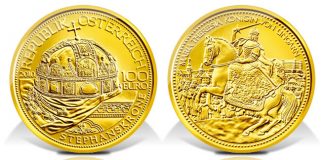
On 5th November, 2008, the Austrian Mint in Vienna launched its new gold commemorative series Crowns of the House of Habsburg.”  The five coin series begins this year with the 1,000 year old crown of the Holy Roman Empire.

Austrian Mint Gold Coin Commemorative of Crown of Holy Roman Empire

When the empire of the Caesars in the west sunk beneath the waves of barbarian invasions, it left a ghostly memory of unity and peace among the peoples of Europe and even among the rulers who had replaced it. On Christmas Day in the year 800 Pope Leo III, seeking a powerful protector from his enemies, crowned the Frankish king Charlemagne in St. Peter’s in Rome, thus reviving the imperial title that had vanished three centuries before.

Charlemagne’s empire, however, declined amidst the squabbles of his heirs, and it was not until the reign of Otto I (936-973) that a territorial empire comparable with that of Rome and Charlemagne existed once more. In 962 Pope John XII, also in search of a protector, crowned Otto I as emperor in Rome.

Read the rest of this entry »

Austria Abbey of Seckau Silver Commemorative Issued

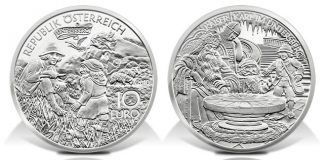
The Austrian Mint in Vienna has issued the last silver 10 euro commemorative in the six-coin series Great Abbeys of Austria. It is dedicated to the Benedictine Abbey of Seckau — a jewel of Romanesque architecture — in the province of northern Styria.

Austria Commemorative 2008 Seckau Abbey Silver Coin

Seckau did not begin its existence as a Benedictine foundation. It was founded in 1140 as an abbey of Augustinian canons regular at St. Marein-Feistritz by a nobleman called Adalram von Waldeck – apparently as a penitential act for the death of his cousin. The place proved unsuitable, and in 1142 the abbey was moved to near-by Seckau. A year later Pope Innocent II placed the new foundation directly under papal protection. It was to be a double monastery with nuns (canonesses) from Salzburg forming a separate but adjoining convent. In 1150 they began to build the splendid Romanesque church which we still see today. In 1259 a fire destroyed much of the wooden ceiling and it was replaced with Gothic stone vaulting instead.

Read the rest of this entry »

Austrian Railways Fourth Silver Commemorative, "Empress Elisabeth West Railway"

The Austrian Mint has issued the fourth 20 Euro silver commemorative coin within the "Austrian Railways" six silver coin series. The coin is dedicated to the "Empress Elisabeth West Railway" from Vienna to Salzburg, which was constructed between 1856 and 1860. It features locomotive "kkStB 306" steaming across an iron railway bridge and a superbly crafted scene depicting the platform hall of the West Railway Station in Vienna.

Austrian Railways Fourth Silver Commemorative, " Empress Elisabeth West Railway"

In the Austrian Empire the railway lines north to the coalfields and factories of Bohemia or south to the harbour of Trieste and the Adriatic shipping lanes were by far the most important. A railway line from Vienna westwards parallel to the Danube River was of less consequence. However, the Kingdom of Bavaria was very anxious to see such a line between Salzburg and Vienna, which would enable trains from Munich to travel eastwards through Hungary and down to Constantinople. Plans by the government to build such a line were subsequently abandoned in 1856 to a private consortium, the Empress Elisabeth Railway Company.

Read the rest of this entry »

World’s Largest Silver Coin from Austria, the Europe Taler 2008

Weighing in at an arm-wrenching 44.2 pounds (20.08 kg) and a gigantic arm-circling 44.6 inches (116.3 cm), the word’s largest silver coin, named the Europe Taler 2008, was unveiled at this year’s European Championship of Football in Austria and Switzerland.

Europe Taler 2008 silver coin

Using the current silver spot price of $16.62 per troy ounce, that makes the coin worth about $23,600 in bullion value alone.

If that’s still a little hefty in price… and in weight for you, smaller coins with nearly 4 ounces (120 grams) of fine silver and a diameter of 2.4 inches (6 cm) will be available soon for the price of € 108 (~$168) plus VAT.

The coins will have a limited mintage set to 2,008. As a bonus, packaging of the coin includes "unique pieces from 500-year old wood."

Read the rest of this entry »

Austrian Railways Third Silver Commemorative, the “Belle Epoque” - Golden Age of Train Travel

The Austrian Mint announces the June 11 release of the third 20 Euro silver commemorative coin within the "Austrian Railways" six silver coin series. The maximum mintage 50,000 proof coin highlights the “Belle Époque” period, featuring locomotive "kkStb 310" and an elegant lady walking the platform of the North Railway Station with its glass roofing and cast-iron pillars.

Austrian Railways Third Silver Commemorative Coin, the “Belle Époque”

The “Belle Époque” covers the period of the late 19th and early 20th centuries. It was a time when trains dominated land travel and reached new heights of comfort and luxury for those classes of society which had the money and time to travel.

It was a time of famous trains like the Orient Express that ran from Paris through Vienna and Budapest down to Constantinople, or the St.Petersburg-Nizza-Cannes-Express, the so-called “Train de Grands-Ducs” that carried the Romanov grand dukes and aristocracy fleeing the Russian winter to warmer southern climates.

Read the rest of this entry »

Austrian Mint Nine-Sided Silver Coin Celebrates 100th Birthday of Herbert von Karajan

The Austrian Mint celebrates the 100th anniversary of the birth of Herbert von Karajan, a 20th century musical giant, with a new nine-sided silver commemorative coin minted in Special Uncirculated and Circulation quality.

Austrian Mint Nine-Sided Silver Coin of Herbert von Karajan

This year Herbert von Karajan would have celebrated his 100th birthday. He was born on 5th April, 1908, in the city of Salzburg. To commemorate this great Austrian conductor the Austrian Mint in Vienna is issuing a 5 Euro silver coin on 7th May, 2008.


On the occasion of his death in 1989 the New York Times characterised Karajan as “probably the world’s best-known conductor and one of the most powerful figures in classical music.”


Read the rest of this entry »

Austrian Mint Launches Commemorative Silver Coins, "The Abbey of Klosterneuburg"

The Abbey of Klosterneuburg coins are the 5th minted in the Austrian Mint’s silver commemorative series “Great Abbeys of Austria”

When one travels down the Danube, whether by river or by land, just before reaching Vienna one encounters the town of Klosterneuburg nestling around the ancient abbey on the heights overlooking the Danube Valley. Since the year 1114 canons regular have been living here according to the Rule of St. Augustine.

Austrian 10 euro Silver "The Abbey of Klosterneuburg" Coin

This abbey is the fifth coin in the Austrian Mint’s silver series “Great Abbeys of Austria” and will be issued on 16th April, 2008.

The Augustinian abbey of Klosterneuburg was founded in 1114 by Margrave Leopold III (who was subsequently canonised and ranks as the patron saint of Austria). The famous legend is that Leopold’s wife, Agnes, lost a precious scarf in the wind which Leopold himself found some years later while hunting.

Read the rest of this entry »

Austrian Mint Releases Silver and Niobium Coin Celebrating the “Fascination of Light”

The Austrian Mint in Vienna has released its silver and niobium coin for 2008, which is dedicated to the “Fascination of Light”. Together with water, light is one of the most important factors of life. Without the light of the sun our planet would be cold and dead.

2008 Austrian Silver-Niobium Coin

The historical occasion for the new coin is the 150 anniversary of the birth of the great Austrian chemist and entrepreneur, Dr. Carl Baron Auer von Welsbach (1858-1929). Among other discoveries Welsbach is remembered for the development of the gas mantle which improved gas lighting in the streets and homes. The gas mantle of 1890 was more robust than earlier methods and produced a “whiter” light.

Read the rest of this entry »