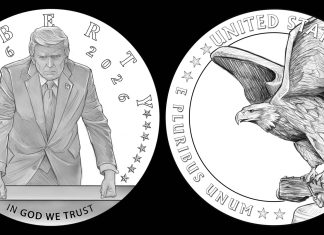
 The Presidential $1 Coin Program would not run its full course if several members of the Senate and House get their way. Two separate pieces of legislation have been introduced in the U.S. Congress which would ultimately end the dollar coins series dedicated to the former Presidents of the United States.
This new legislation comes in response to recent media attention to a reported $1 billion plus worth of dollar coins held in storage by Federal Reserve Banks. (Check out the PDF of the Annual Report to the Congress on the Presidential $1 Coin Program from the Board of Governors of the Federal Reserve System.) The massive stash of coins has been building up over the years with a marked increase occurring since the introduction of Presidential dollars four years ago.
Most attribute the inventory of dollar coins to two major factors. First, the public’s resistance to the use of dollar coins for everyday circulation. Second, requirements pertaining to the dollar coins placed on both the US Mint and the Reserve Banks.
When Congress created the legislation for the Presidential series in 2005, undoubtedly one of main reasons behind it was to win the public over to the idea that dollar coins could be used for daily commerce transactions. If it had occurred, it may have led to an easy transition from the $1 banknote which ends up costing significantly more to produce over the long-term in comparison to a coin. Currently, $1 banknotes have an expected life of 42 months according to the Bureau of Engraving and Printing. The United States Mint lists the life span of a coin at 25 years.
It is also not the first time Congress attempted to put dollar coins into meaningful circulation. In 1971, Eisenhower Dollars were first minted but proved unpopular with the public owing to their size. They were followed in 1979 by the Susan B. Anthony Dollar which also proved unpopular despite being much smaller. Finally, in 2000, the Sacagawea Dollar made its way to the public but never took traction when it came to commerce.
Then, in 2005, Congress passed the Presidential Coin Act of 2005. It sought to increase interest in the $1 coin by honoring the former Presidents of the United States on their obverse. The program debuted in 2007 and is scheduled to run through at least 2016 with four new dollar coins appearing per year honoring the Presidents in the order in which they served.
However, in passing that Act, Congress also placed certain demands on their production. For one, it initially required that at least 1/3 of the total number of dollar coins produced in a year still feature the Sacagawea design. (That percentage was later decreased to 20% of the total.) In addition, a mandatory introductory period was established which required Federal Reserve Banks to have sufficient supplies on hand of each of the new designs to insure broad public availability.
Together, the lack of interest in the coins and the mandated production and distribution meant that many more of the coins have been produced than are needed, which led to the build-up. However, if passed, the proposed legislation would remedy that problem.
H.R. 2593 was introduced in the House of Representatives by Rep. Jackie Speier of California and is cosponsored by Rep. Jared Polis of Colorado. Entitled the Wasteful Presidential Coin Act of 2011, the proposed legislation would strike subsection (n) of Section 5112 of title 31 which authorized the Presidential $1 Coin Program. It would further limit the number of Sacagawea Coins produced by adding:
"no $1 coin may be minted or issued under this section during any period in which the number of $1 coins issued, but not in circulation, is more than 10 percent of the number of $1 coins in circulation" to Section 5112 of title 31.
A bill was also introduced in the United States Senate by Sen. David Vitter of Louisiana and cosponsored by Sen. Jim DeMint of South Carolina. S. 1385 , entitled A bill to terminate the $1 presidential coin program, would strike subsection (n) and replace it with "(n) [Reserved]." (Read one collector’s perspective on this bill at Coin Collectors Blog.)
Either legislation, if it became law, would see the end of the Presidential $1 Coin in its entirety. In addition, it would likely also affect the associated First Spouse Gold Coin Program which are issued in conjunction with the Presidential dollars coins.
For proposed coin legislation to become law, it must pass in both chambers of Congress and win the signature of the President of the United States.