
The only known 1974-D aluminum Lincoln cent has been returned to the United States Mint after decades in private possession and a short legal battle.
Randall Lawrence and Michael McConnell relinquished all claims of ownership, legal title, or dominion over the coin following an agreement to resolve a lawsuit over who owns it. U.S. Mint officials are now in the process of authenticating it.
"The Mint is very pleased with the agreement, and we are very grateful to the U.S. Attorney’s Office in San Diego for its work and efforts in reaching this resolution. We look forward to displaying the coin appropriately as an important Mint heritage asset," said Rhett Jeppson, United States Mint Principal Deputy Director. "This agreement is not only good for the integrity of the coin collecting hobby but for the integrity of the government property and rule of law."
The 1974-D aluminum Lincoln Cent was originally in the possession of Harry Lawrence who served as Deputy Director of the Denver Mint until his retirement in 1980. His son, Randall, assumed custody of the coin as part of his father’s estate.
"When he died in 1980, that coin and others he received over the years were in a plastic sandwich bag," Randy Lawrence described back in January 2014. "I kept them in that bag in my desk for 33 years… I had no idea what that penny was worth."
In 1974, over 1.4 million of the experimental pieces were struck at the U.S. Mint in Philadelphia as part of a test program to possibly replace copper cents. However, Congress never enacted legislation authorizing the Mint to issue aluminum cents, and the test pieces were to all be melted. The specimen coin in question bears a "D" mark, signifying production in Denver, along with the date "1974," and appears to have been struck with a die intended for the Mint’s Denver facility. However, authority was never granted for production of the experimental test pieces at Denver.
The story of the Philadelphia-struck Lincoln cents being sufficiently explained and documented leaves no mention of similar coins being produced at the Denver Mint. Just a letter to the editor in the March 20, 2001 edition of Numismatic News sent by Michael P. Lantz suggested their existence.
The letter stated that Lantz worked the graveyard shift at the Denver Mint and witnessed the test striking of aluminum cents. The handful, about ten, was taken by the foreman to the Coining Division office to be shipped back to Mint headquarters in Washington, D.C. Their fate, with the exception of this specimen, is unknown.
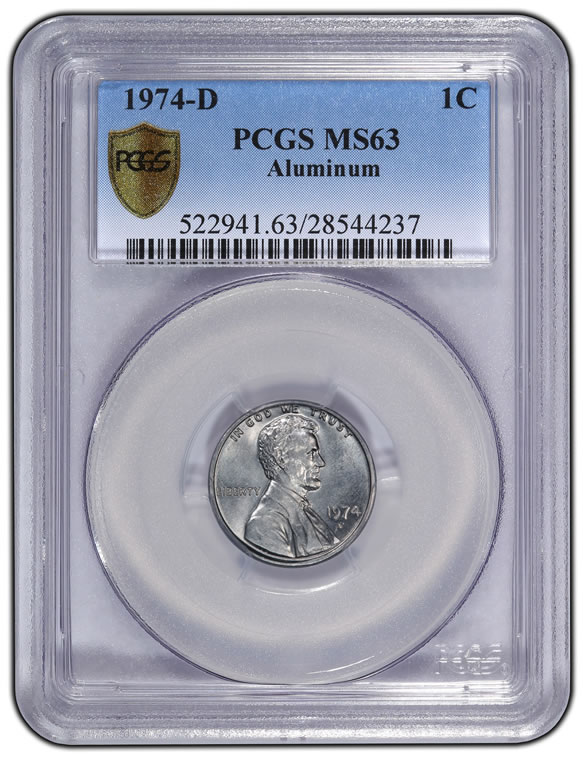
Still having no idea about its rarity, Randall Lawrence sold the cent along with others from his father’s collection to La Jolla Coin Shop, which is owned by Michael McConnell. Not certain of the story behind the piece, McConnell sent it to PCGS who authenticated and certified it as a Denver-struck 1974 aluminum cent in grade MS63.
Upon hearing of the coin’s rarity, McConnell contacted Lawrence with the two opting to work out a deal to sell the coin at auction with a large portion of the proceeds to be given to charity.
When learning of the sale, officials at the U.S. Mint contacted Lawrence and McConnell to seek the coin’s return, indicating it was unlawfully removed from the Denver Mint. Lawrence and McConnell responded by filing suit in United States District Court for the Southern District of California seeking a judicial declaration that they were the lawful owners of the piece.
The U.S. Mint filed a response asking that the court dismiss the complaint, which was granted with a ruling that Lawrence and McConnell failed to prove the coin was legally owned. A judge allowed them to file an amended complaint. They did, with part of the amended filing offering some background as to how Lawrence received the coin, stating:
"The Denver Mint commemorated Harry Lawrence’s impending retirement in 1979 by (a) giving him a clock engraved with his name and dates of service and with the "hours" represented by specimens of each of the last 90%-silver coins minted in Denver in 1964, and (b) allowing him to keep certain error coins struck in Denver which he had accumulated, and one specimen of the 1974-D aluminum cent. Harry Lawrence died in 1980, and Plaintiff LAWRENCE obtained the clock, the error coins, and the 1974-D aluminum cent that is the subject of this action along with his father’s other personal property."
With the settlement in place, U.S. Mint Police secured the cent on Friday, March 17. The Mint intends to publicly display the coin so that it can be "showcased and enjoyed by numismatists, coin collectors and the general public."