
Daily Archives: November 4, 2009
2010 Year of the Tiger Silver Coins
The Chinese lunar calendar is known to be thousands of years old but they still use it today to mark special events and festivities. In fact, their system is known worldwide along with the twelve animals used to differentiate its cycles.
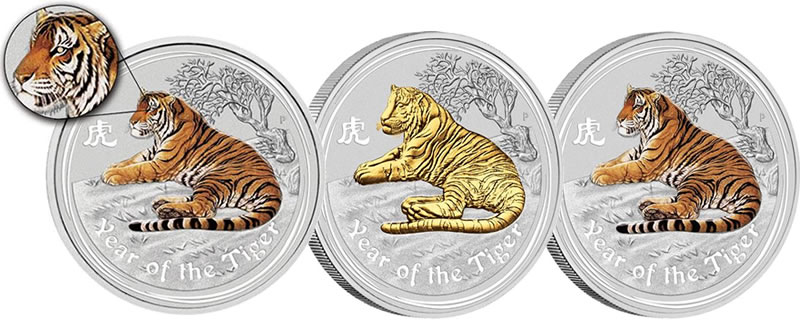
CLICK TO ENLARGE: 2010 Year of the Tiger Silver Coins: Gemstone, gilded and colorized versions
Said to signify the courage and competitiveness of a natural leader, the tiger is one of those twelve animals and is found on some of the newest releases from The Perth Mint. The 2010 Year of the Tiger Silver Coins feature a variety of options for the collector or gift giver.
Perhaps the most popular in this series will be the colored tiger silver coin. Struck from one ounce of 99.9% pure silver, the 1 dollar face value coin shows a lying tiger that has been colorized to its natural hues. To the left of the tiger is the Chinese character for the animal while underneath is the inscription 'Year of the Tiger.' The colored coin is available from the Perth Mint for $68.18 AUS and ships with a presentation case. It is limited to a mintage of 170,000 worldwide.
Gold Nears $1,100/oz, US Stocks Close Mixed
Braille Commemorative Silver Dollar Deadline Announced
19th Annual Penny Harvest Commences
Austrian Mint Launches Crown of an Archduke Gold Coin
The second 100 Euro coin in the gold series "Crowns of the House of Habsburg" will be released on Wednesday, 4th November. It is dedicated to the so-called "Archduke's Hat", a name derived from the red velvet cap within the crown itself.
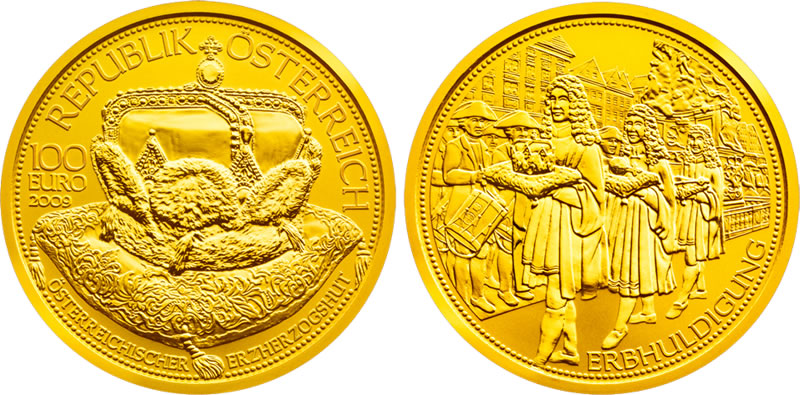
CLICK TO ENLARGE: Austrian 100 euro Crown of an Archduke Gold Coin
The title of archduke was invented by Rudolf IV in the spurious document of 1358/59 called the privilegium maius. It was an attempt to assert the status of the House of Habsburg as the equal of any Prince Elector of the Holy Roman Empire. There exists a mediaeval portrait of Rudolf wearing a crown similar to the Archduke's Hat. Early versions of the crown have not survived, being either broken up or melted down.
In 1616, however, Archduke Maximilian III of Tyrol had the present Archduke's Hat fashioned and he gave it to the Augustinian Abbey of Klosterneuburg just outside Vienna in honour of St. Leopold, whose tomb and shrine are still situated there to this day. The crown was not worn as such. There was no coronation. It was rather a symbol of authority and rank. It was brought into Vienna only for the ceremony of homage paid by the Estates of Lower Austria on the accession of a new Habsburg ruler. Even today the crown is not permitted to be outside the walls of the abbey for more than 30 days at a time.